Work you can check.
Seven studies we ran ourselves: transonic pressure against wind-tunnel data, hull sinkage against towing-tank measurements, and five applied studies taken from geometry to a defensible recommendation. Every page shows the result and the boundary of what it claims.
How much cooling capacity does your layout cost you?
An independent study we ran on our own bench: four ways of arranging 42 dry coolers around a 44 MW-class data hall. The dense baseline quietly lost about 12% of its cooling capacity to its own exhaust; a better layout cut that penalty to about 5%.
- +2.46 KBEST INTAKE RISE
- 4LAYOUTS COMPARED
- 5 DAYSILLUSTRATIVE SCHEDULE
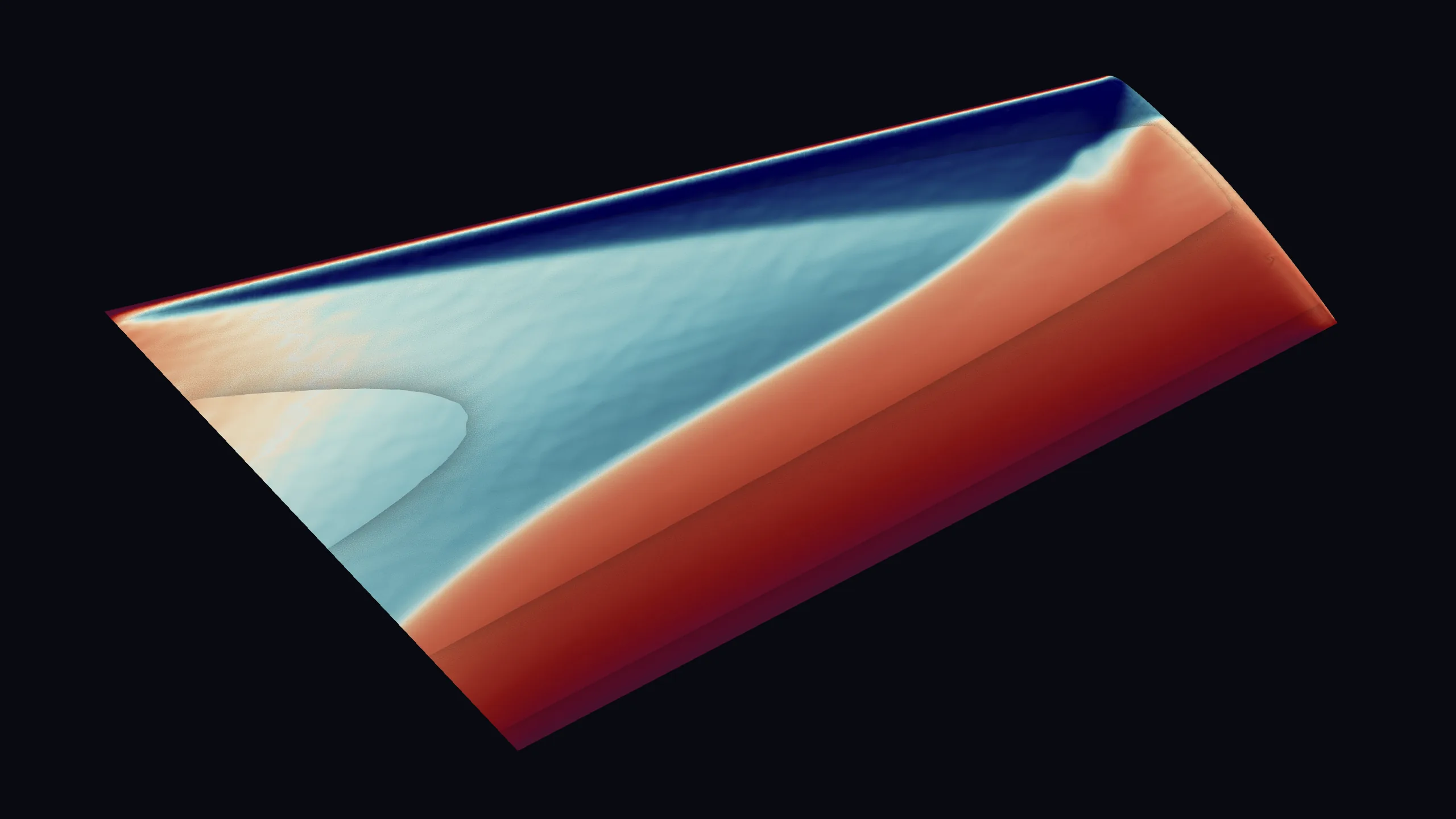
The λ-shock, where the wind tunnel puts it.
The ONERA M6 wing at Mach 0.8395 against AGARD AR-138. 270 of 271 pressure taps, and the double-shock structure captured and merging where the experiment brackets it. Lift sits 1.1% from the midpoint of a NASA multi-code band — a code-to-code check, not validation; there is no measured lift or drag for the M6.
- 0.071POOLED RMS ΔCp · 270 TAPS
- −1.14%CL VS BAND MIDPOINT · CODE-TO-CODE
- 12.96 MCELLS
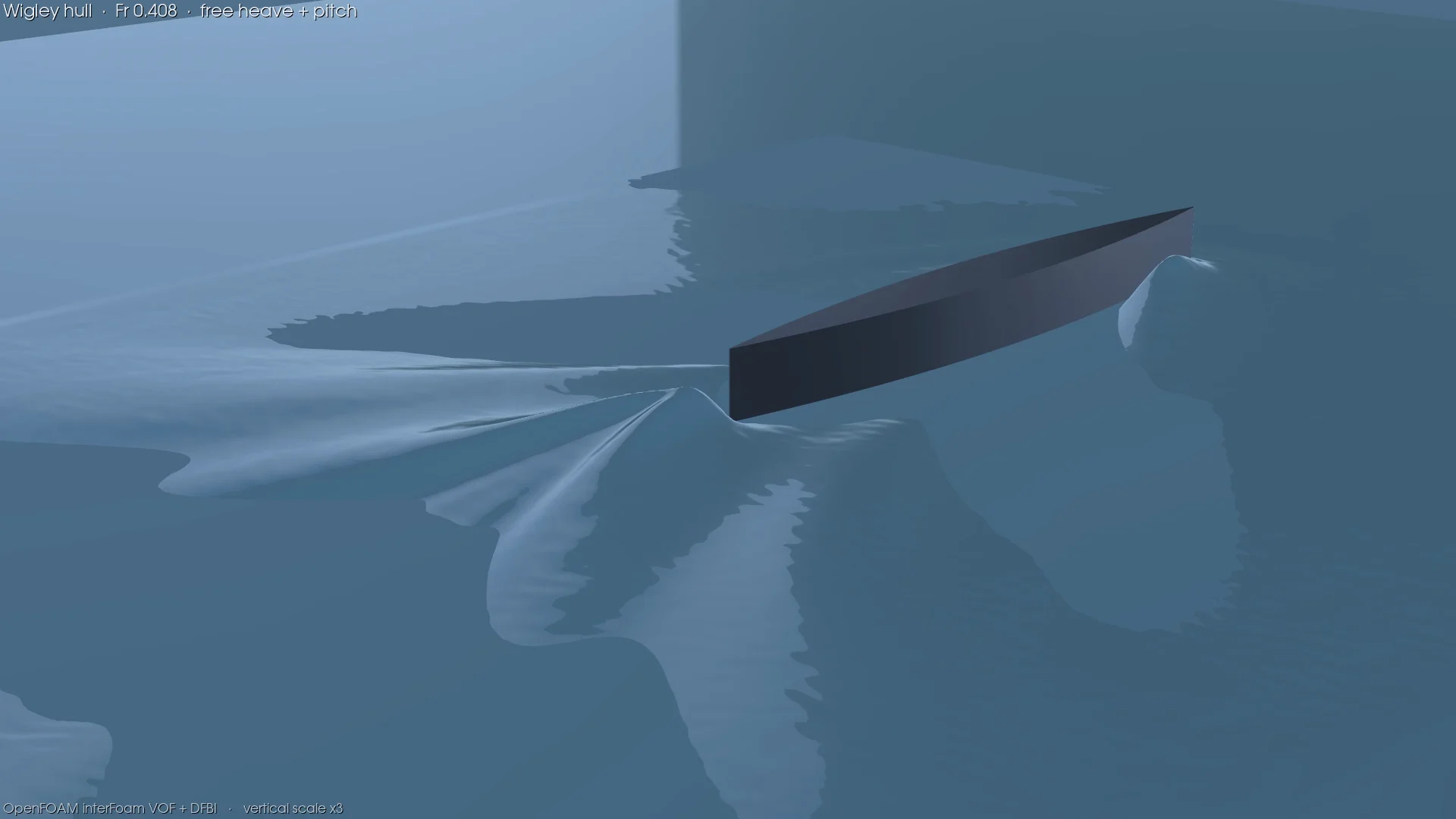
Sinkage within 1.03 mm, across five speeds.
The 3 m Wigley hull from Fr 0.177 to 0.408, against the 1983 towing-tank measurements. Every sinkage result landed within 1.03 mm — but only after a constant +6.6 mm offset gave away a datum bug that no amount of physics tuning would have fixed. Total resistance is verified to ±2.10% on a converged grid family.
- ≤1.03 MMSINKAGE ERROR · FIVE SPEEDS
- ±2.10%CT NUMERICAL UNCERTAINTY
- 0.99–1.07SKIN FRICTION CV/CF
Where sludge settles, and the aim that decides it.
A 12 m storage tank with two shell-mounted mixing nozzles. The pump, the nozzles and the flow rate are fixed; the only variable is which way the nozzles point. Aimed radially across the tank, they leave 90% of the floor below the shear stress that mobilises settled sludge. Turned 53° to spin the tank instead, they leave 62%, and the tank-side pressure the loop has to overcome falls by 751 Pa rather than rising.
- 90% → 62%FLOOR BELOW SLUDGE THRESHOLD
- 4.0×MORE SWEPT FLOOR AREA
- 0NEW HARDWARE · SAME PUMP

The elbow that starves a heat exchanger.
A short-radius bend discharging into an exchanger casing delivers 13.8% RMS non-uniformity across the tube face, against a 10% purchase specification, with 16% of the plenum recirculating. Turning vanes inside the existing elbow clear the specification and take pressure off the fan rather than adding it. Add a distribution plate to those same vanes and the face reaches 1.9%, still cheaper to run than the duct as drawn.
- 13.8%AS DESIGNED · SPEC IS 10%
- 1.9%RMS · VANES AND PLATE
- −26 PAFAN DUTY, NOT MORE

The house that only cools when the wind blows.
A heavily glazed house designed on the assumption that wind would ventilate it. Its two openable windows sit at the same height. In a 3 m/s breeze that gives 13 air changes an hour; in still air it gives 0.73, and the mezzanine reaches 35.7 °C with the outdoor air at 24 °C. Roof vents 4.5 m above the windows remove the dependence on the weather, since the height matters more than the hole, and shading the glass reaches a similar place on a fraction of the air flow.
- 0.73 ACHSTILL AIR, AS BUILT
- 35.7 °CMEZZANINE · 24 °C OUTSIDE
- −5.8 KMEZZANINE, WITH ROOF VENTS

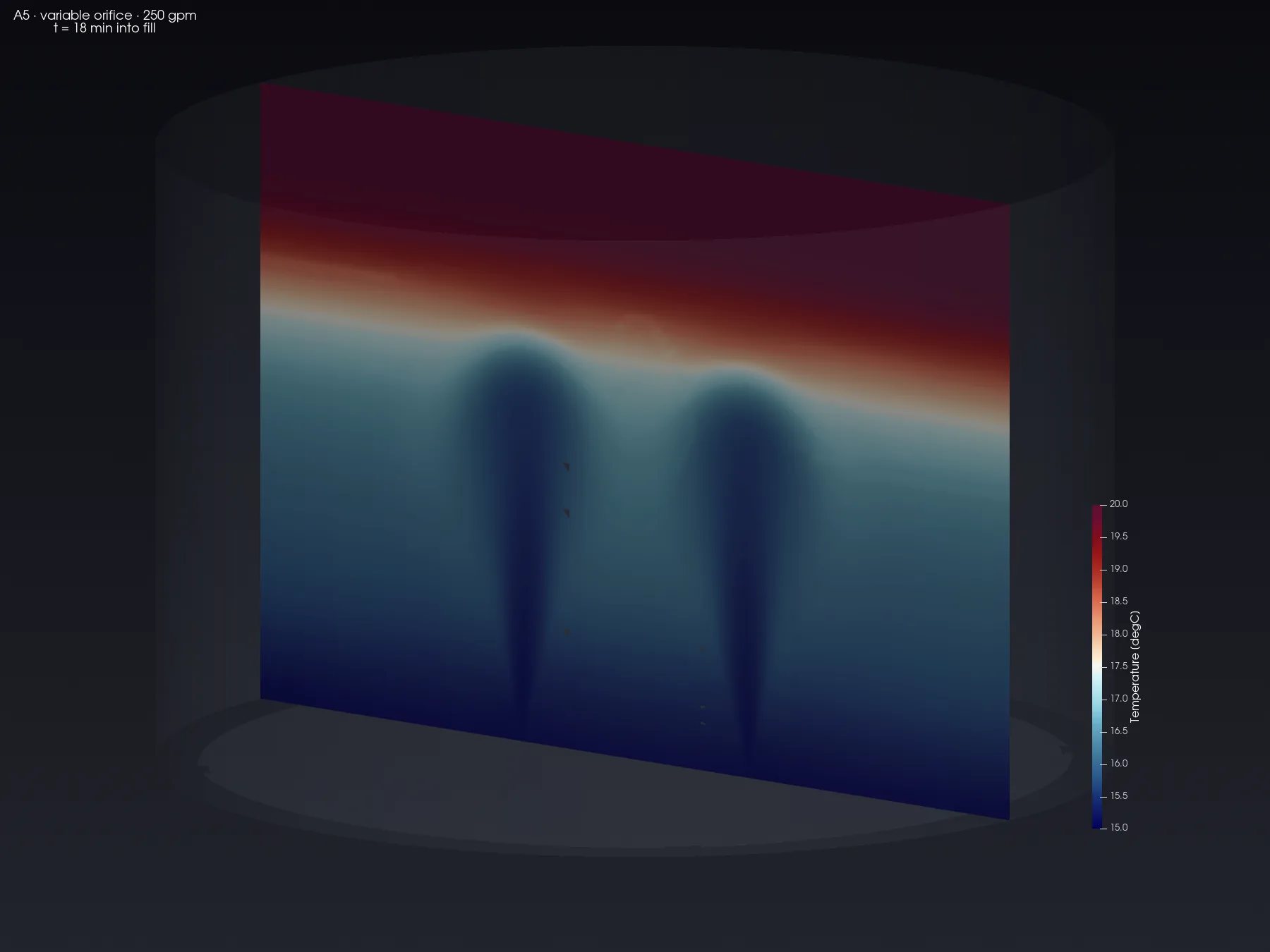
What decides whether a storage tank actually mixes.
A transient, buoyancy-driven simulation of jet mixing in a stratified 246,727-gallon potable water tank, across five inlet configurations run concurrently on one workstation. Destratification is set by the momentum flux the inlet delivers, not by flow rate and not by Froude number: two cases whose Froude numbers differ by 2.8× land within 1.1% of each other because their momentum flux is identical.
- 2.7×MORE MIXING AT THE SAME FLOW
- 1.6%APART ON A CONTROLLED MESH
- 2.8 HFIVE CASES, ONE WORKSTATION
You don't need a finished brief.
Send the geometry, the operating point, and the decision you're trying to make, and we'll tell you what can be answered and the fastest defensible way to get there.