Drag coefficient
The drag coefficient, , says how much drag a shape produces for its size and speed. It has no units. Compared on the same reference area and Reynolds number, a lower number means a more slippery shape.
The drag equation
This is the drag equation. is the drag force, the fluid density, the speed and the reference area.
The reference area changes with the field. Cars and bluff bodies use frontal area. Aircraft use wing area. Ship hulls use wetted surface area. A drag coefficient means nothing without knowing which area it uses.
Typical values
| Shape | Drag coefficient |
|---|---|
| Flat plate facing the flow | 1.28 |
| Long cylinder across the flow | 1.2 |
| Cube | 1.05 |
| Sphere | 0.47 |
| Modern car | 0.25 to 0.35 |
| Streamlined body | 0.04 |
These values hold over a range of speeds, not at all of them. A smooth sphere's drag coefficient falls from about 0.47 to roughly 0.1 near a Reynolds number of 300,000. That sudden fall is called the drag crisis.
A worked example
A car has a drag coefficient of 0.30 and a frontal area of 2.2 m². It drives at 30 m/s, about 108 km/h, through air at 1.225 kg/m³.
- Drag is 364 N.
- The power to push through the air is drag times speed, 10.9 kW.
At half the speed, drag falls to a quarter and power to an eighth, 1.4 kW. That is why highway speed costs so much range.
Pressure drag and friction drag
Total drag has two parts. Pressure drag comes from the low-pressure wake behind a body. It dominates for blunt shapes. Friction drag comes from air shearing along the surface. It dominates for long, slender shapes such as wings and hulls. Streamlining works by shrinking the wake.
Where it matters
- Range and energy. Drag sets most of the energy a road vehicle or drone uses at speed. See aerodynamics for lift as well.
- Wind loads. Drag on signs, antennas and buildings sizes the structure that holds them.
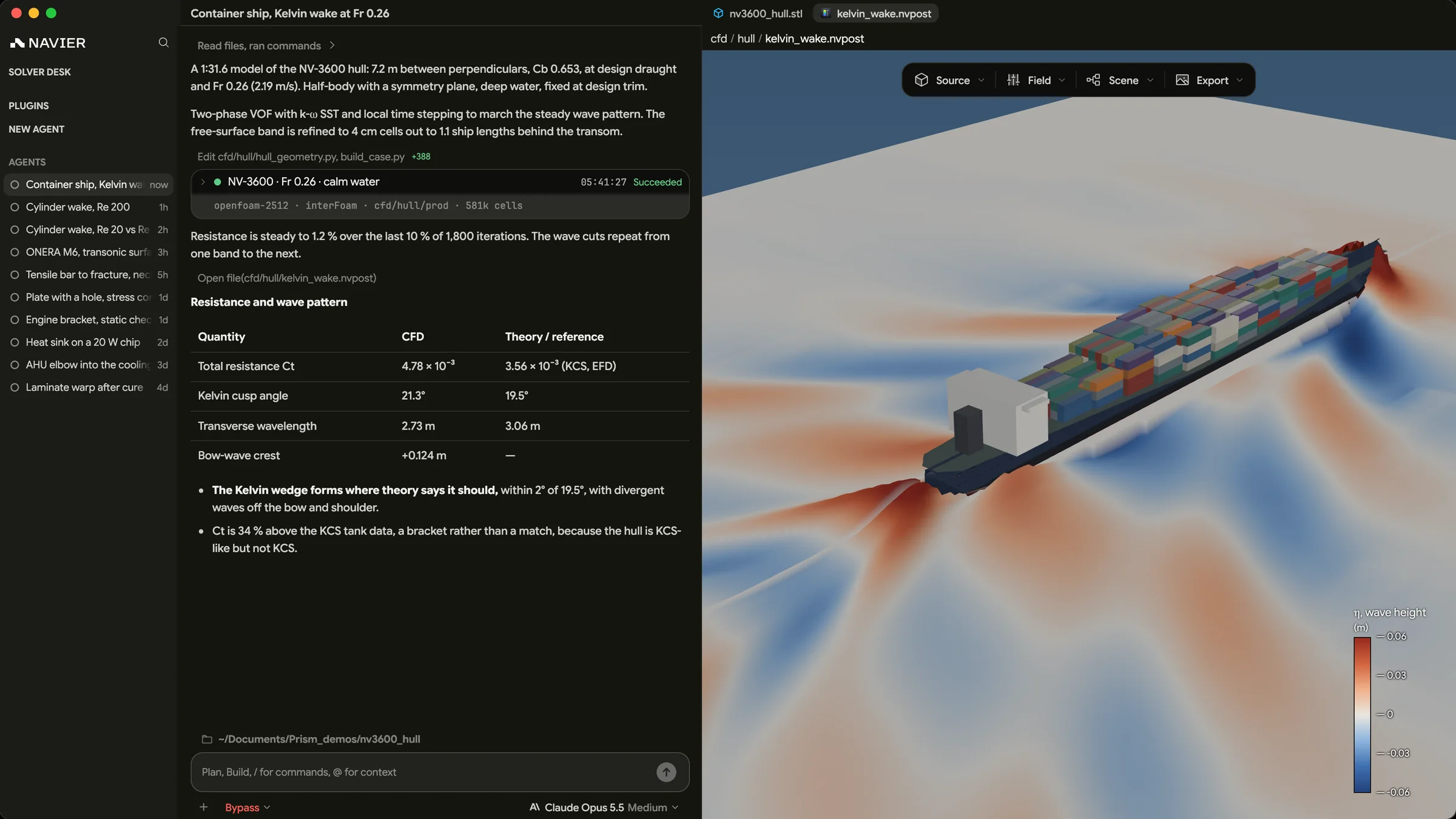
- Ships. Hull resistance sets the engine and the fuel bill.
- Falling and settling. Drag sets the terminal speed of particles, droplets and parachutes.
Common mistakes
- Mixing reference areas. A wing-area coefficient and a frontal-area coefficient can't be compared.
- Quoting a coefficient without its Reynolds number. The same shape can have very different values at different speeds and sizes.
- Reporting only total drag from CFD. Splitting it into pressure and friction shows which part the mesh got wrong.
Drag coefficient using Navier AI
Prism runs CFD with OpenFOAM, SU2 and Basilisk, and the agent reports forces and coefficients with the plots behind them.
Our ONERA M6 study splits drag into pressure and viscous parts. The viscous part lands 0.34% above the top of a wall-resolved reference band. The Wigley hull study reports a total resistance coefficient of 5.638 × 10⁻³ at a Froude number of 0.316, with a 2.10% numerical uncertainty. Download Prism to run your own.
References
- S. F. Hoerner, Fluid-Dynamic Drag, Hoerner Fluid Dynamics, 1965.
- F. M. White, Fluid Mechanics, McGraw-Hill.