Aerodynamics
Aerodynamics is the study of how air flows around a solid body and the forces that flow produces. Engineers use it to predict lift, drag and surface pressure on wings, vehicles, buildings and fan blades.
Lift and drag
Air pushes on every point of a surface, through pressure and through friction. Add those pushes up and they resolve into two forces. Lift acts across the oncoming flow. Drag acts along it.
Here is air density, is airspeed and is the reference area. and are the lift and drag coefficients. The term is the dynamic pressure.
A wing makes lift by turning the air downward. That leaves lower pressure over the top surface and higher pressure under it. Lift grows with angle of attack until the flow separates from the upper surface. That point is the stall, at around 15 degrees for many airfoils.
Speed regimes
| Regime | Mach number | What changes |
|---|---|---|
| Incompressible | below 0.3 | Density barely changes, so simpler models hold |
| Subsonic | 0.3 to 0.8 | Compressibility starts to matter |
| Transonic | 0.8 to 1.2 | Shocks form on parts of the body and drag rises sharply |
| Supersonic | 1.2 to 5 | The flow is supersonic everywhere, with shock waves and wave drag |
| Hypersonic | above 5 | Heating and air chemistry matter |
A worked example
A small drone wing has an area of 0.5 m² and flies at 20 m/s at sea level, where air density is 1.225 kg/m³.
- Dynamic pressure is Pa.
- With a lift coefficient of 0.8, lift is 98 N. That carries about 10 kg.
- With a drag coefficient of 0.04, drag is 4.9 N.
The lift-to-drag ratio is 20. Double the speed and both forces grow four times.
Where it matters
- Range and energy use of aircraft, drones and road vehicles.
- Wind loads on buildings, antennas and outdoor equipment.
- Cooling air through radiators, electronics enclosures and data center yards.
- Blade design for fans, propellers and wind turbines.
Common mistakes
- Treating air as incompressible above about Mach 0.3. Density changes start to shift the answer.
- Testing a scale model at the wrong Reynolds number. A small model runs at a lower Reynolds number, so the flow may separate on the model and stay attached on the full-size part.
- Trusting CFD drag from a coarse wall mesh. Friction drag depends on resolving the thin layer of air at the surface.
Aerodynamics using Navier AI
Prism runs CFD with OpenFOAM, SU2 and Basilisk. The agent sets up the case, runs it on your machine and checks the result. Every case file stays in your project.
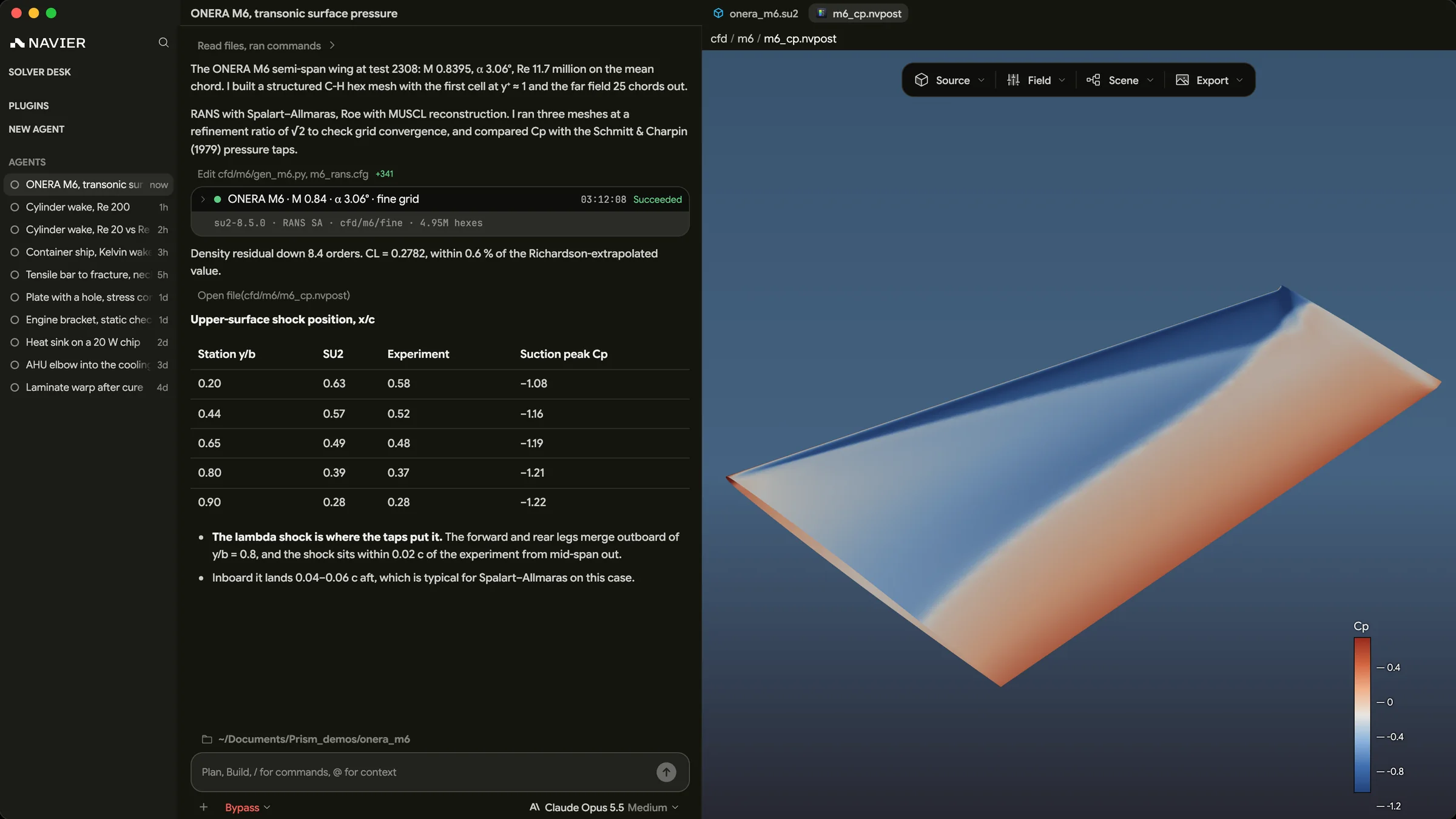
Our ONERA M6 study runs the standard transonic wing at Mach 0.8395. It compares surface pressure against 270 of the 271 wind-tunnel taps, and the double shock on the upper surface merges where the experiment puts it. Download Prism to run your own.
References
- J. D. Anderson, Fundamentals of Aerodynamics, McGraw-Hill.
- F. M. White, Fluid Mechanics, McGraw-Hill.