Von Mises stress
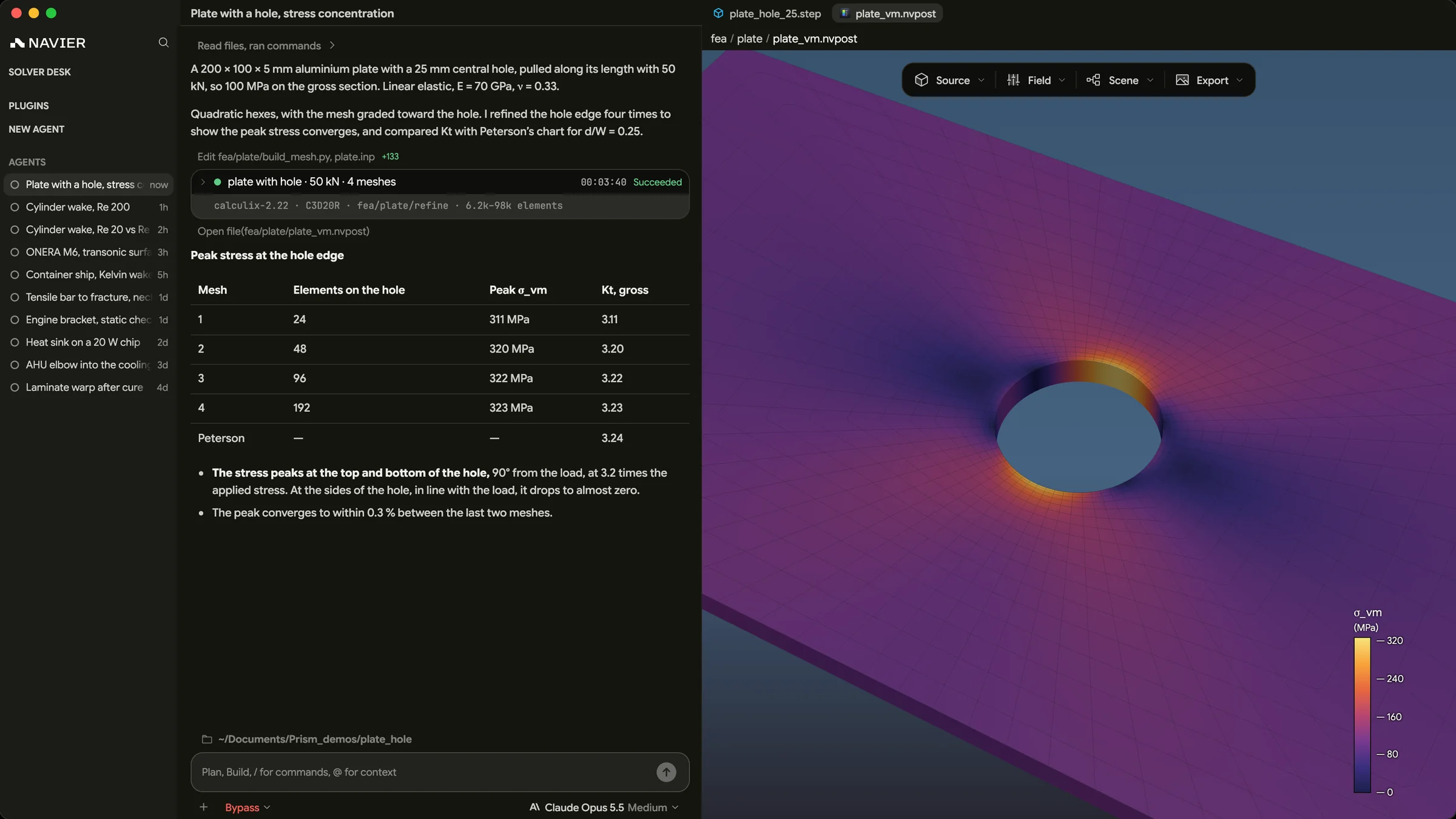
Von Mises stress is one number that stands in for a full 3D stress state. A ductile metal is predicted to yield when its von Mises stress reaches the yield strength from a simple tensile test.
That is why it is the default stress plot in most FEA tools. The idea is that metals yield from the part of the stress that changes their shape, not the part that changes their volume. Pressure equal on all sides gives zero von Mises stress, however high it is.
The formulas
From the three principal stresses,
For one normal stress and one shear stress, as on the surface of a shaft in bending and torsion,
The part is predicted to yield when reaches the yield strength . The safety factor is .
A worked example
A 30 mm solid steel shaft carries a bending moment of 200 N·m and a torque of 300 N·m.
- Bending stress is 75.5 MPa.
- Shear stress from torsion is 56.6 MPa.
- Von Mises stress is 123.7 MPa.
For a steel with a 350 MPa yield strength, the safety factor is about 2.8.
Von Mises and Tresca
The Tresca criterion predicts yield from the largest shear stress alone. For the same shaft it gives 136.0 MPa, about 10% higher.
| Von Mises | Tresca | |
|---|---|---|
| Based on | Shape-changing energy | Largest shear stress |
| Shaft example | 123.7 MPa | 136.0 MPa |
| Against test data | Closer for ductile metals | Up to 15% conservative |
| Typical use | FEA and general design | Hand checks and codes that require it |
When not to use it
- Brittle materials such as cast iron and ceramics fail in tension. Use the largest principal stress instead.
- Composites are much stronger along the fibres than across them. They need ply-level criteria such as Tsai–Wu.
- Fatigue with a mean stress. Von Mises stress is never negative, so it can't tell a tensile mean from a compressive one. Use a signed or critical-plane method.
- Buckling is a stability limit. A slender part can buckle far below yield.
Where it matters
- Static strength checks of shafts, brackets, pressure vessels and welds in ductile metal.
- Reading FEA results. It is the stress plot most engineers look at first.
- Margins. Design reviews quote the safety factor against yield from it.
Common mistakes
- Reporting the peak at a sharp corner or point load, where the value keeps rising with mesh refinement. See finite element analysis.
- Comparing with ultimate strength instead of yield.
- Calling a linear result above yield a real stress. Once a part yields, the load moves elsewhere.
Von Mises stress using Navier AI
Prism runs structural FEA on Ferro, its built-in solver, with CalculiX, code_aster and Elmer available from inside the app. The agent sets up the model, runs it on your machine, and writes the report as a PDF or a deck on your team's template.
For a material where von Mises doesn't apply, our composite layup study checks four carbon/epoxy layups ply by ply with Tsai–Wu and Tsai–Hill instead. Download Prism to run your own.
References
- R. G. Budynas and J. K. Nisbett, Shigley's Mechanical Engineering Design, McGraw-Hill.
- R. von Mises, "Mechanik der festen Körper im plastisch-deformablen Zustand," Nachrichten von der Gesellschaft der Wissenschaften zu Göttingen, 1913.