Thermal expansion
Thermal expansion is the change in a part's size when its temperature changes. Most materials grow as they heat and shrink as they cool. A part that can't move freely builds up stress instead.
The formula
is the coefficient of thermal expansion, the original length and the temperature change. Volume grows by about three times that fraction.
If the part is held at both ends and can't grow, the expansion turns into stress.
is Young's modulus. The stress doesn't depend on the part's length.
Coefficients for common materials
| Material | α, 10⁻⁶ per K |
|---|---|
| Aluminium | 23 |
| Copper | 17 |
| Stainless steel 304 | 17 |
| Carbon steel | 12 |
| Titanium Ti-6Al-4V | 8.6 |
| Borosilicate glass | 3.3 |
| Invar | 1.2 |
| Carbon fibre, along the fibre | slightly below 0 |
A worked example
A 6061-T6 aluminium spacer, 200 mm long and 20 mm square, heats from 20 °C to 70 °C.
- Free to move, it grows 0.23 mm.
- Clamped between two rigid plates, it can't grow. The stress is 79 MPa in compression.
That is about 29% of its yield strength, from a 50 K change and no load at all. The spacer is short and stocky enough not to buckle. A long, slender rail held the same way would bow sideways well before it reached that stress.
Where it matters
- Joints between different materials. Aluminium bolted to steel grows twice as much, so the joint slips, loosens or cracks.
- Electronics. Solder joints fatigue as a board and its chips expand by different amounts every power cycle.
- Clearances. Shafts, bearings and housings need gaps that work at both cold and hot.
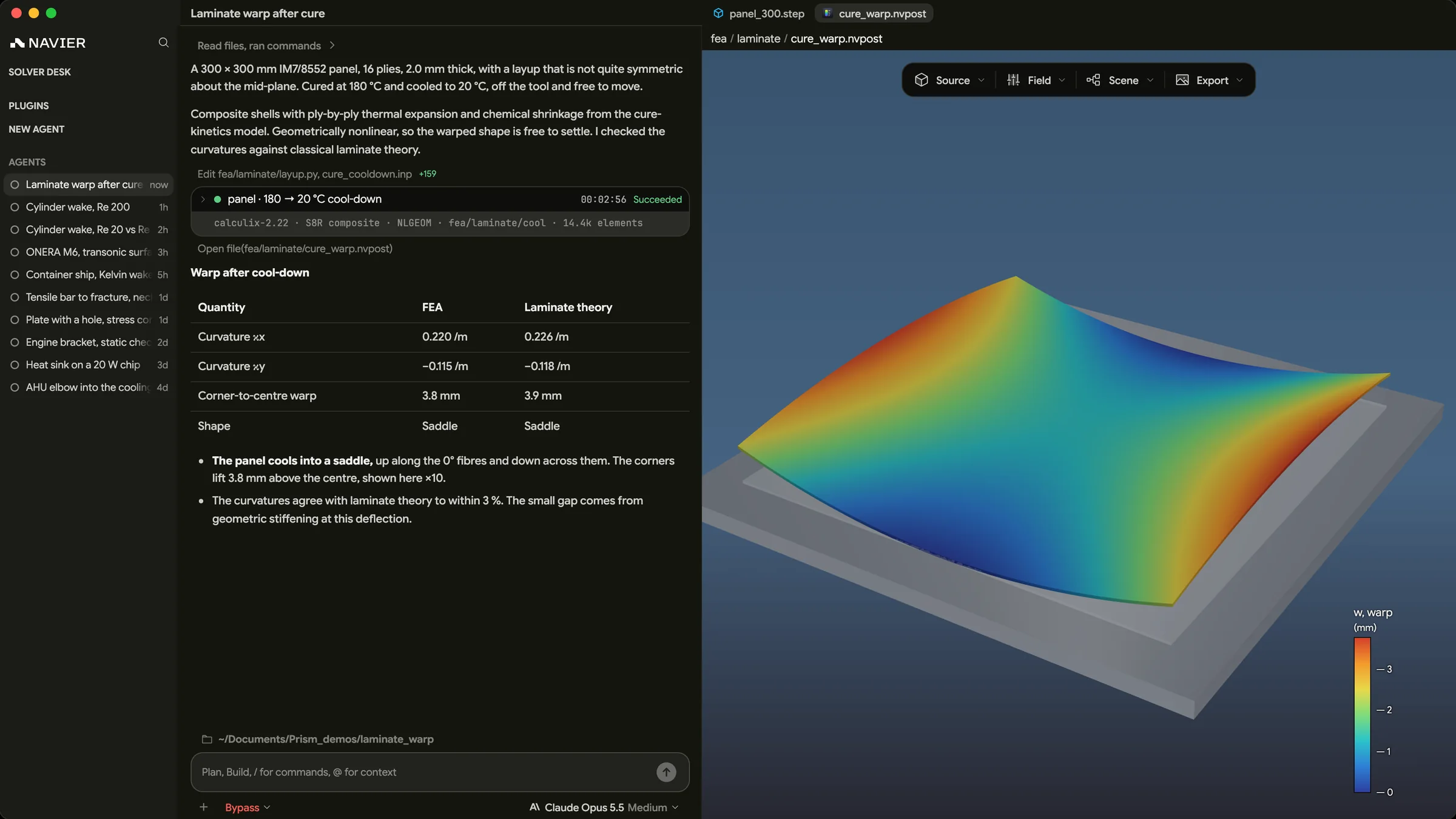
- Composites. Parts cure hot and cool down, which leaves stress in the plies.
Common mistakes
- Forgetting the constraint. A part at one even temperature that expands freely has no thermal stress. The same part bolted down can yield. A part with a temperature gradient is stressed even when it is free.
- Using one coefficient over a wide range. It rises with temperature for most metals.
- Choosing the wrong stress-free temperature. For a cured composite or a weld it is the process temperature, not room temperature.
Thermal expansion using Navier AI
Prism runs structural FEA on Ferro, its built-in solver, with CalculiX, code_aster and Elmer available from inside the app.
Our composite layup study treats each plate as stress-free at its 453 K cure. On cooling, a ply contracts across its fibres by 28 × 10⁻⁶ per kelvin and barely moves along them. The 160 K cool-down alone leaves the cross-ply and quasi-isotropic plies at 81% of their transverse strength, before any load arrives. Download Prism to run your own.
References
- W. D. Callister and D. G. Rethwisch, Materials Science and Engineering, Wiley.
- R. G. Budynas and J. K. Nisbett, Shigley's Mechanical Engineering Design, McGraw-Hill.