Heat transfer
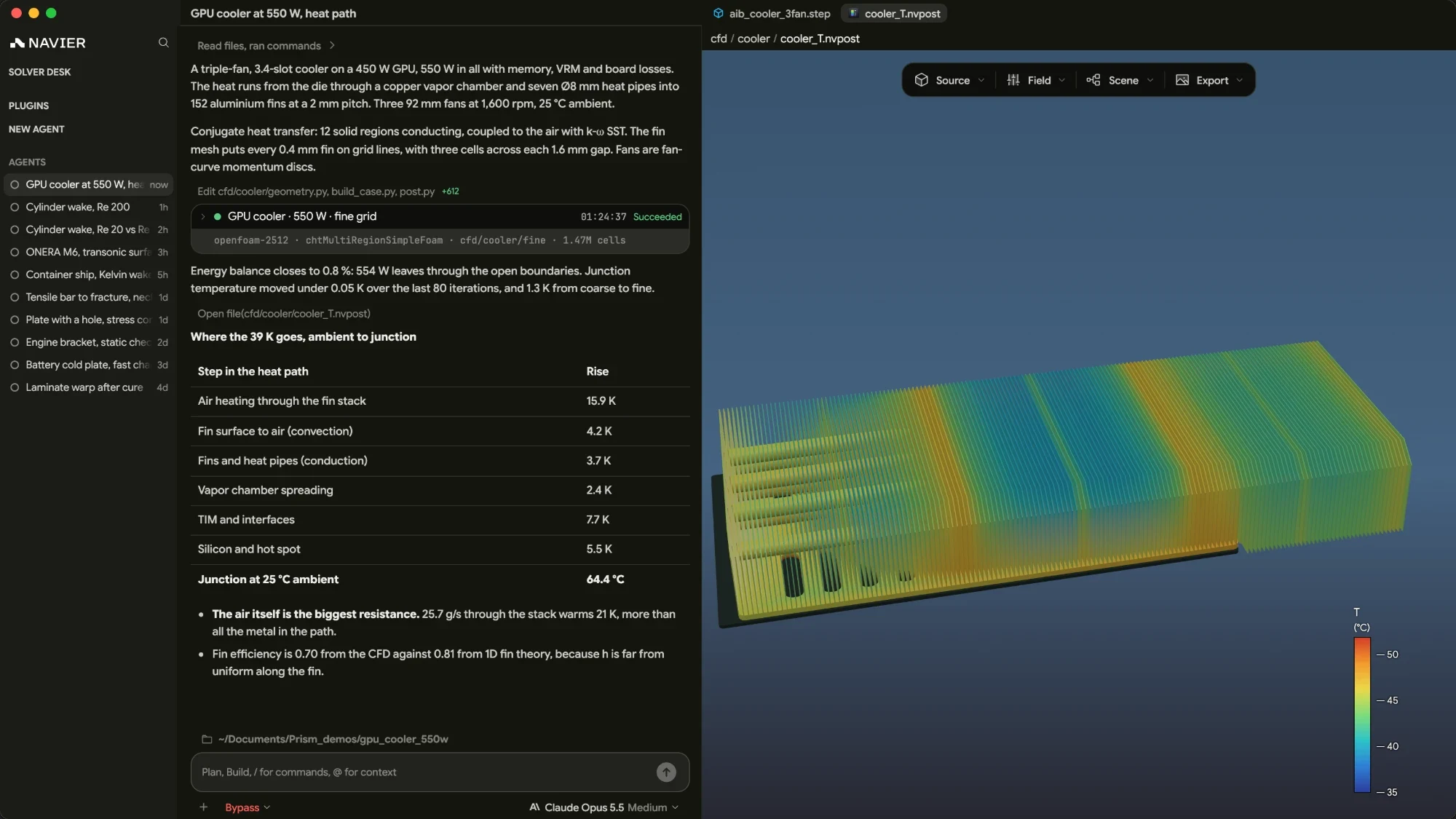
Heat transfer is the movement of thermal energy from a hotter place to a colder one. It happens by conduction, convection and radiation. Most real designs involve all three at once.
The three modes
Conduction moves heat through a solid, or a fluid at rest, from molecule to molecule. Fourier's law gives the heat flux.
Convection moves heat between a surface and a moving fluid. Newton's law of cooling wraps the fluid's behaviour into one heat transfer coefficient, .
Radiation moves heat as infrared light and needs no medium at all. It matters most at high temperatures and in a vacuum.
Here is thermal conductivity, is surface emissivity and is the Stefan–Boltzmann constant, 5.67 × 10⁻⁸ W/m²K⁴.
Thermal conductivity of common materials
| Material | k, W/m·K |
|---|---|
| Copper | 400 |
| Aluminium 6061 | 167 |
| Carbon steel | 50 |
| Stainless steel 304 | 16 |
| Water | 0.6 |
| Air | 0.026 |
The heat transfer coefficient depends on both the flow and the fluid. Still air gives 2 to 25 W/m²K. Air from a fan gives 25 to 250. Pumped water gives hundreds to thousands.
A worked example
A 20 W component sits on a 50 × 50 mm aluminium plate, 3 mm thick. A fan blows air over the other face with = 50 W/m²K.
- Conduction through the plate takes K/W. The plate costs 0.14 K.
- Convection into the air takes K/W. The air side costs 160 K.
Almost all of the rise is on the air side. Four times the area, a 100 × 100 mm plate or a finned heat sink, brings it down to 40 K.
Where it matters
- Electronics and battery cooling, where a few degrees decide lifetime.
- Data centers, where cooling sets how much compute a site can run.
- Engines and exhausts, where parts run close to their material limits.
- Thermal stress, because temperature changes make parts expand.
Common mistakes
- Ignoring contact resistance. Two bolted surfaces touch at only a few points, so a thermal pad or paste often matters more than the plate.
- Taking one textbook value of h. It changes with flow speed and geometry, so it usually needs a correlation or a simulation.
- Leaving out radiation. In still room air it carries about as much heat as natural convection. In a vacuum or above a few hundred degrees it often dominates.
- Solving steady state when the load is a short pulse that a part can absorb.
Heat transfer using Navier AI
Prism runs thermal and flow simulation, and the agent sets up the case, runs it on your machine and reports the temperatures that matter.
Our data center cooling study compares four ways of arranging 42 dry coolers around a data hall. The dense layout loses about 12% of its cooling capacity to its own hot exhaust. The best layout cuts that to about 5%. Download Prism to run your own.
References
- T. L. Bergman, A. S. Lavine, F. P. Incropera and D. P. DeWitt, Fundamentals of Heat and Mass Transfer, Wiley.
- Y. A. Çengel and A. J. Ghajar, Heat and Mass Transfer, McGraw-Hill.