Heat exchangers
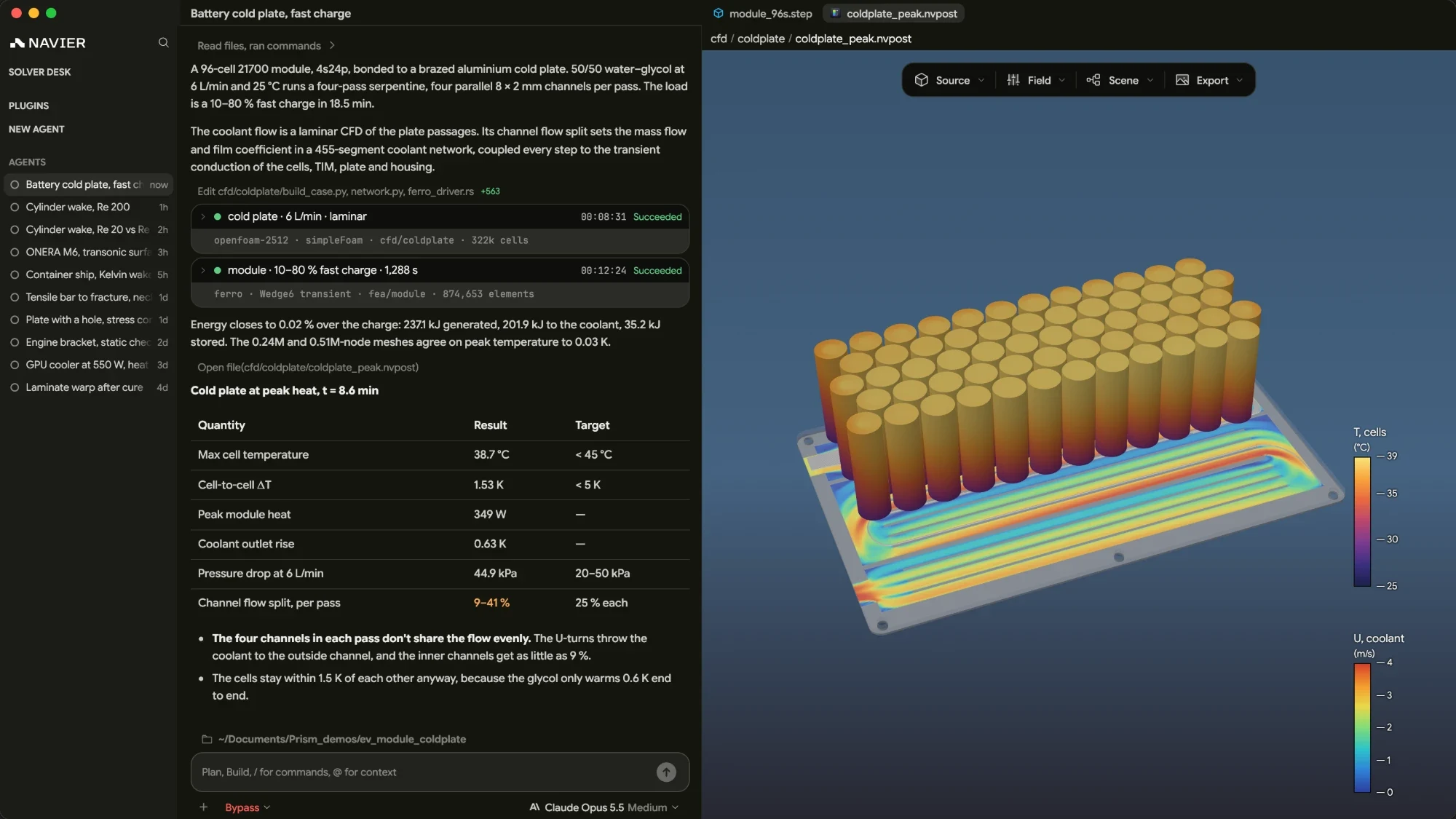
A heat exchanger moves heat from one fluid to another without letting them mix. Car radiators, HVAC coils, oil coolers and data center dry coolers are all heat exchangers. A cold plate does the same job between a hot part and a liquid coolant.
The main types
- Shell and tube
- Plate
- Finned tube
- Plate fin
- Cold plate
- Double pipe
| Type | Where it fits |
|---|---|
| Shell and tube | Large duties and high pressures, such as oil, chemical and power plants |
| Plate | Compact and efficient for liquid to liquid duties, such as HVAC and food processing |
| Finned tube | Liquid to air, such as radiators, condensers and dry coolers |
| Plate fin | Very compact and light, such as aircraft and cryogenic systems |
| Cold plate | Liquid cooling of electronics and battery packs, where heat passes from a part into the coolant |
| Double pipe | Small duties where simple and cheap matters most |
How the two streams meet matters as much as the type. In counterflow they run in opposite directions, which gets the most heat across. In parallel flow they run the same way, which needs more area for the same duty. Crossflow, common in air coolers, sits between the two.
Sizing with LMTD
The heat a unit can move is
is the overall heat transfer coefficient and the transfer area. and are the temperature differences between the two streams at each end. The log mean is used because the gap between the streams changes along the unit.
A worked example
Oil must cool from 90 °C to 50 °C, a 30 kW duty. Cooling water warms from 20 °C to 35 °C, and is 300 W/m²K.
- Counterflow. The end differences are 55 K and 30 K, so the LMTD is 41.2 K. The area is 2.42 m².
- Parallel flow. The end differences are 70 K and 15 K, so the LMTD is 35.7 K. The area is 2.80 m².
Counterflow does the same job with about 13% less area.
Where it matters
- Flow distribution. A unit sized for even flow underperforms when the inlet duct feeds one side more than the other.
- Fouling. Deposits build up on the surfaces and add resistance over time.
- Pressure drop. More area and tighter passages move more heat but cost pump or fan power.
Common mistakes
- Sizing on the average temperature difference instead of the log mean. It overstates what the unit can do.
- Leaving out a fouling allowance. The unit meets spec on day one and falls short a year later.
- Assuming the air or water arrives evenly across the face.
Heat exchangers using Navier AI
Prism runs CFD with OpenFOAM, SU2 and Basilisk, so the agent can model the ducts and headers that feed a heat exchanger.
Our heat exchanger duct study finds that a short-radius elbow leaves 13.8% non-uniformity across the tube face, against a 10% purchase spec. Turning vanes clear the spec and take 26 Pa off the fan. Vanes with a distribution plate reach 1.9%. Download Prism to run your own.
References
- T. L. Bergman, A. S. Lavine, F. P. Incropera and D. P. DeWitt, Fundamentals of Heat and Mass Transfer, Wiley.
- R. K. Shah and D. P. Sekulić, Fundamentals of Heat Exchanger Design, Wiley.