Introducing Prism: The AI Platform for Hardware Engineering
By Cameron & Evan
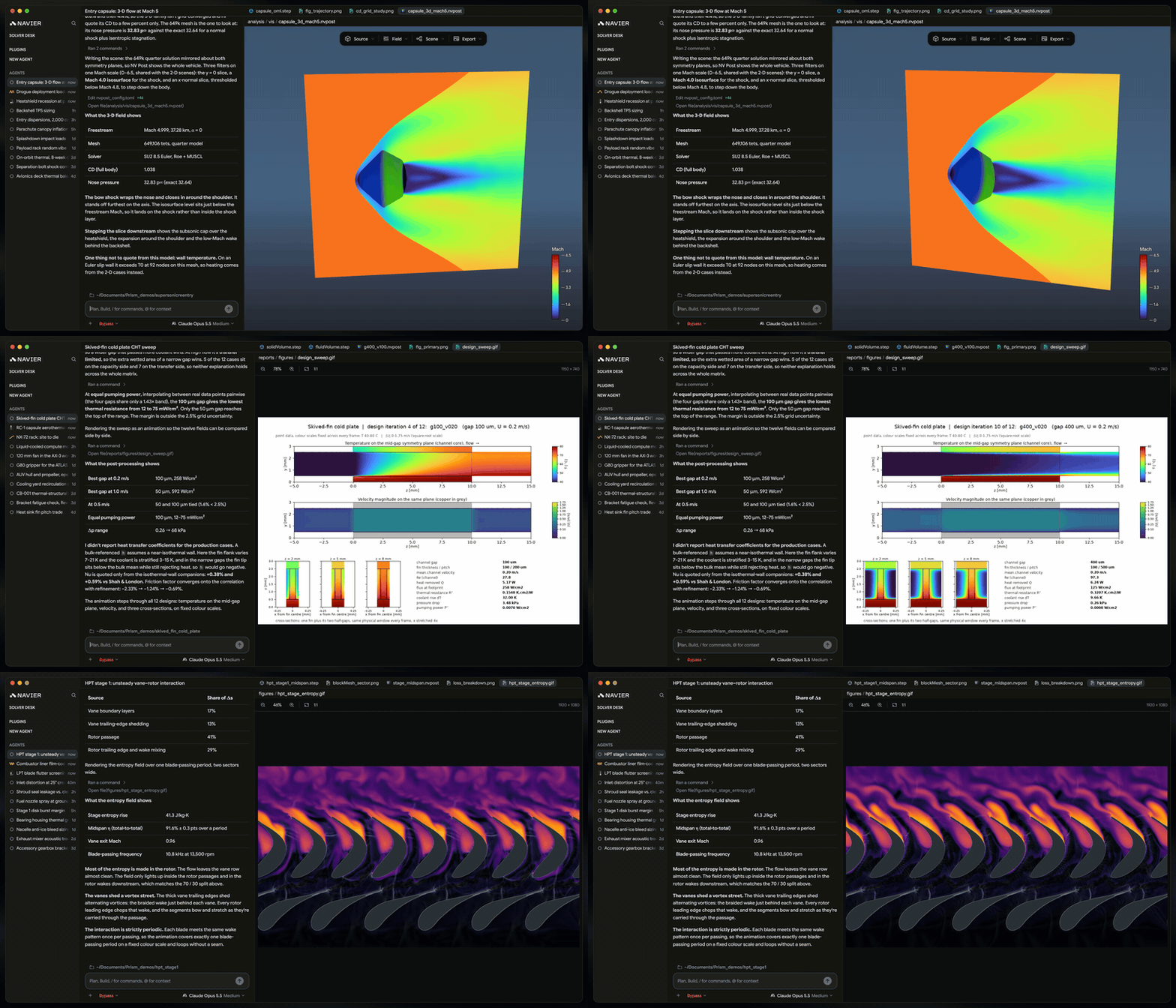
Over the past year, coding agents have changed what a software engineer's day looks like. Less of it goes to writing code by hand. More of it goes to the decisions that shape a system: how to structure the architecture, how to model the data, where the interfaces belong and which tradeoffs are worth making. The agent writes the code. The engineer decides what to build and whether it's right.
Hardware engineers haven't had that shift yet.
They still spend much of the week doing the work by hand. They export geometry, clean it up until the mesher accepts it, rebuild the simulation setup for the tenth variant, write one-off scripts to pull numbers out of results files, and paste plots into slides. The real engineering, like choosing which concept to pursue, where the margins are and what the next test needs to prove, gets whatever time is left.
Earlier in our careers, we watched this happen at SpaceX, General Atomics, Aurora, Astranis and more. Some of the best engineers we've worked with spent most of their week on manual point-and-click work that had nothing to do with engineering.
Today we're launching Prism to give hardware engineers the same shift: less time doing the work by hand, and more time on the decisions that matter.
The broken hardware toolchain
A single design study can cross over half a dozen tools: a CAD package, a mesher, a solver, a post-processor, Python or MATLAB, and finally PowerPoint. None of them were built to talk to each other. Every handoff is manual. You export, re-import and fix whatever broke on the way, and every design change sends you back through the whole chain.
Cameron hit this hardest while leading vehicle engineering on hydrofoiling boats. To speed up simulation loops, he spent years scripting together CAD and simulation tools into a custom pipeline. Even then, the loop was so slow and fragile that the simulation workflow, not the engineering, became the constraint on the pace of iteration.
When each study takes days, teams commit to a direction early and test only a handful of variants. Most of the design space goes unexplored, and the problems a broader study would have caught show up in physical testing, where they're most expensive to fix.
What Prism Is
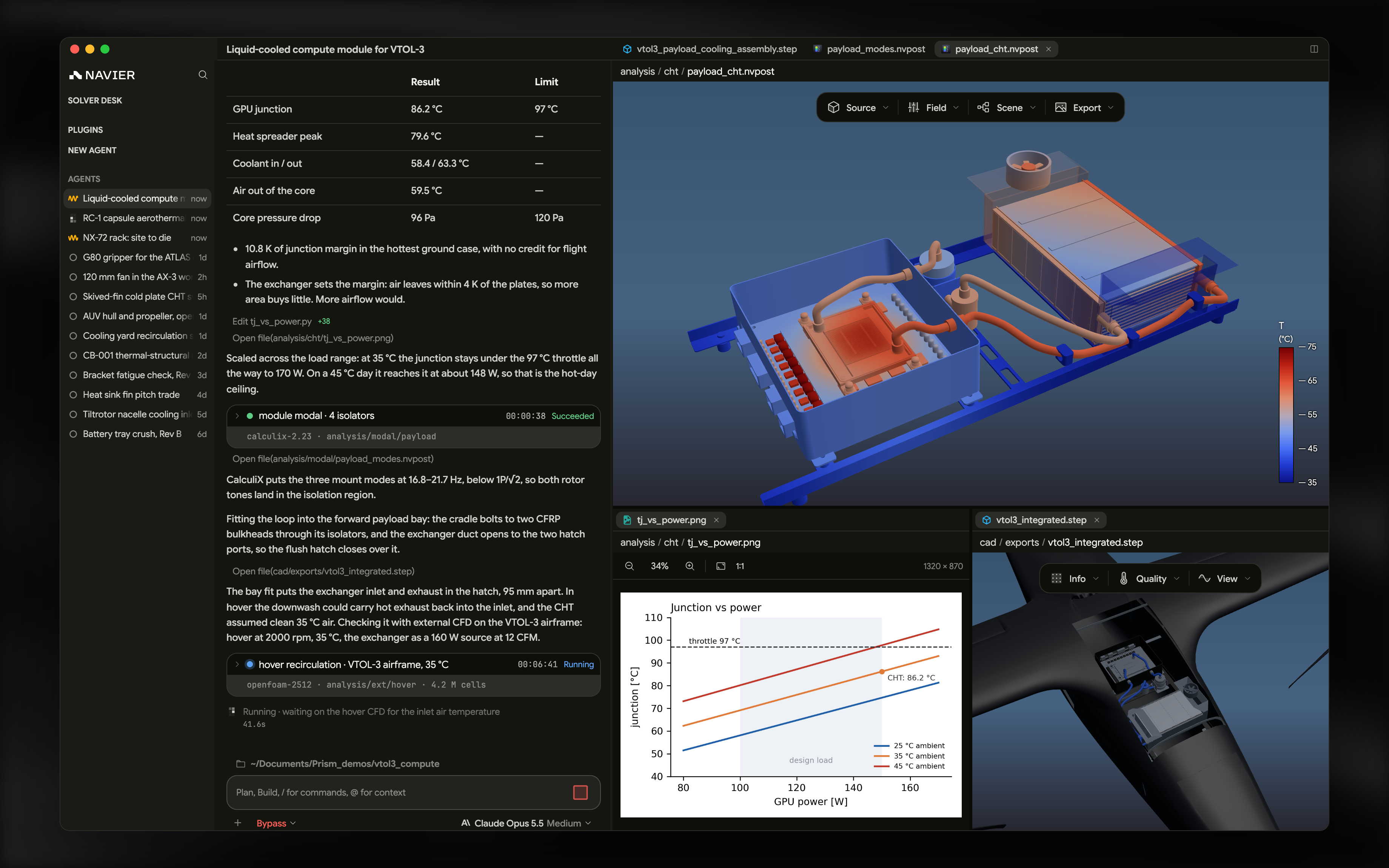
Prism is a desktop app that puts everything an engineer needs in one environment, and hands it to AI agents that can drive all of it.
Engineering knowledge: The agent ships with a knowledge layer that encodes how an experienced engineer approaches hardware. That includes knowing how to build CAD models, set up simulations across different solvers, generate quality meshes, post-process results, assess designs for manufacturability, and write engineering reports.
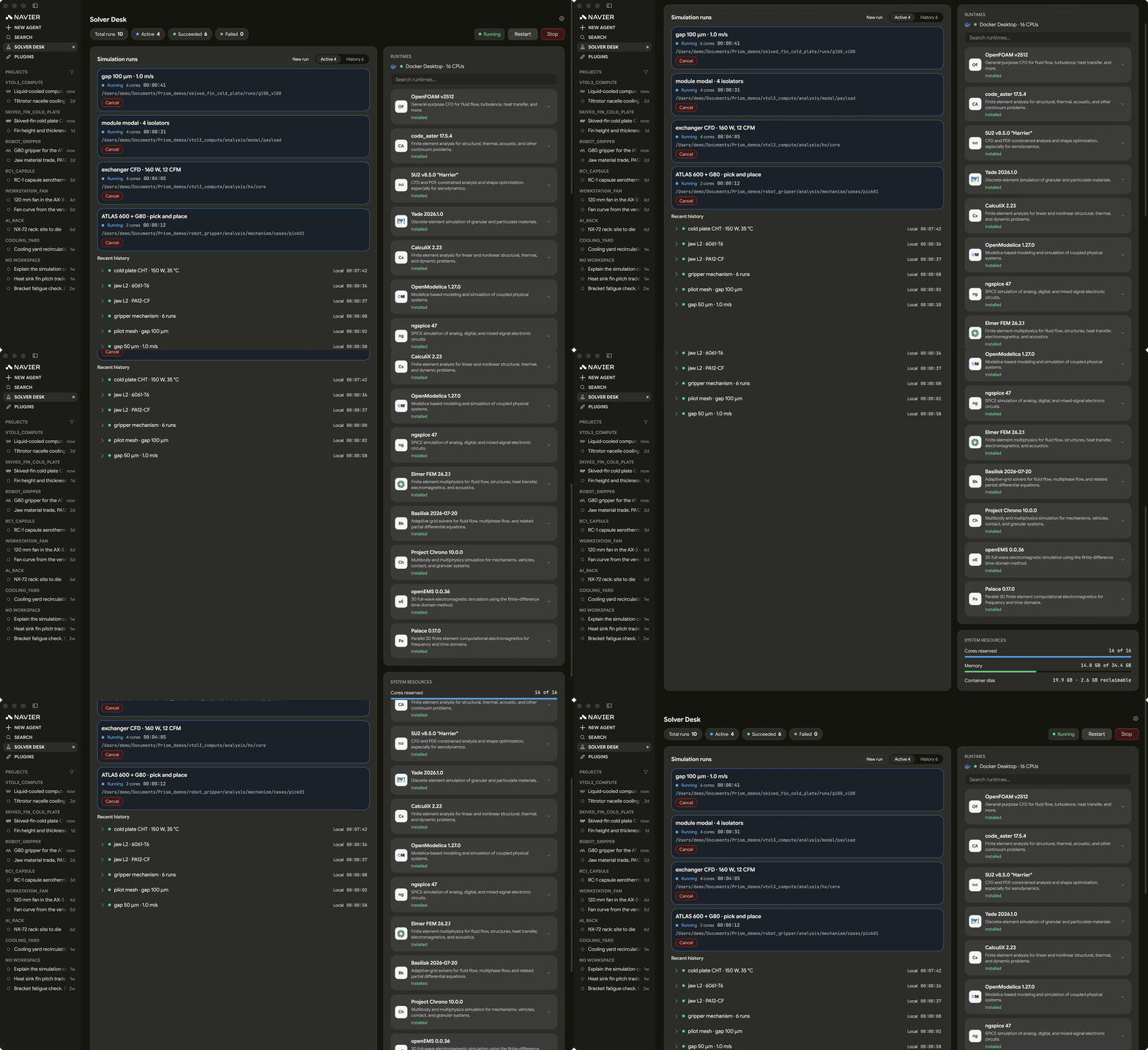
Physics solvers: Twelve open-source solver families run locally on your machine, including OpenFOAM, CalculiX, code_aster, SU2, Elmer and Project Chrono. Every run is tracked from the integrated Solver Desk. Prism also includes Ferro, the FEA solver we built in-house to run on the GPU.
CAD and 3D viewers: The agent builds CAD on the Open CASCADE kernel. STEP files, meshes and result fields all open in the 3D viewport, so you and the agent are always looking at the same model.
A coding agent built for hardware: It handles first-order sizing scripts, data reduction, test automation and embedded firmware, with a full editor, a terminal and a diff of every file the agent touched.
Connections to your stack: Plugins for Onshape, GitHub, Jira and Confluence, and Notion ship in the box. You can also add your own MCP servers, or write skills that encode your team's conventions.
Nothing is hidden. Every script, assumption, mesh and solver input is a file in your project folder. Ask the agent for a plan before it touches anything, then review its work the way you'd review a colleague's.
The agent does the busy work. You make the engineering calls.
How We Designed Prism
One environment for the whole engineering workflow. When an agent has every tool the job needs, including CAD, meshing, solvers, post-processing, code and reporting, it can execute a full workflow end to end, from requirements to final report. And with solvers across every domain in the same workspace, it can start doing multi-physics optimization. For example, it can trade cooling performance against structural margin and mass in a single loop, instead of handing the design from one discipline to the next.
Proven solvers, not learned approximations. We started Navier building physics-ML models that predicted CFD results 100,000× faster than a traditional solve. They were fast, but they weren't general. Every new problem needed new training data, and generating it cost more than running the simulations. (We told that story in Introducing Agent-Driven Engineering.) The bigger lesson was that the solver was rarely the bottleneck. The human loop around it was. So Prism runs the solvers engineers already trust, and every result can be checked the usual way.
Show the work. Engineers are right to distrust numbers they can't verify, and no agent will be perfect. Prism's agent reports what it ran, what it assumed and how it checked the answer, and the files are openly available to check. When it's wrong, you can see exactly where.
From Prompt to Validated Design: A Drone Cooling Module
Here's what working with Prism looks like end to end.
We asked the agent to design a cooling module for a drone and attached a CSV of design constraints. That was the whole brief.
The agent read the constraints, proposed a set of candidate configurations and built parametric CAD for the module to fit into the loading bay of the drone.
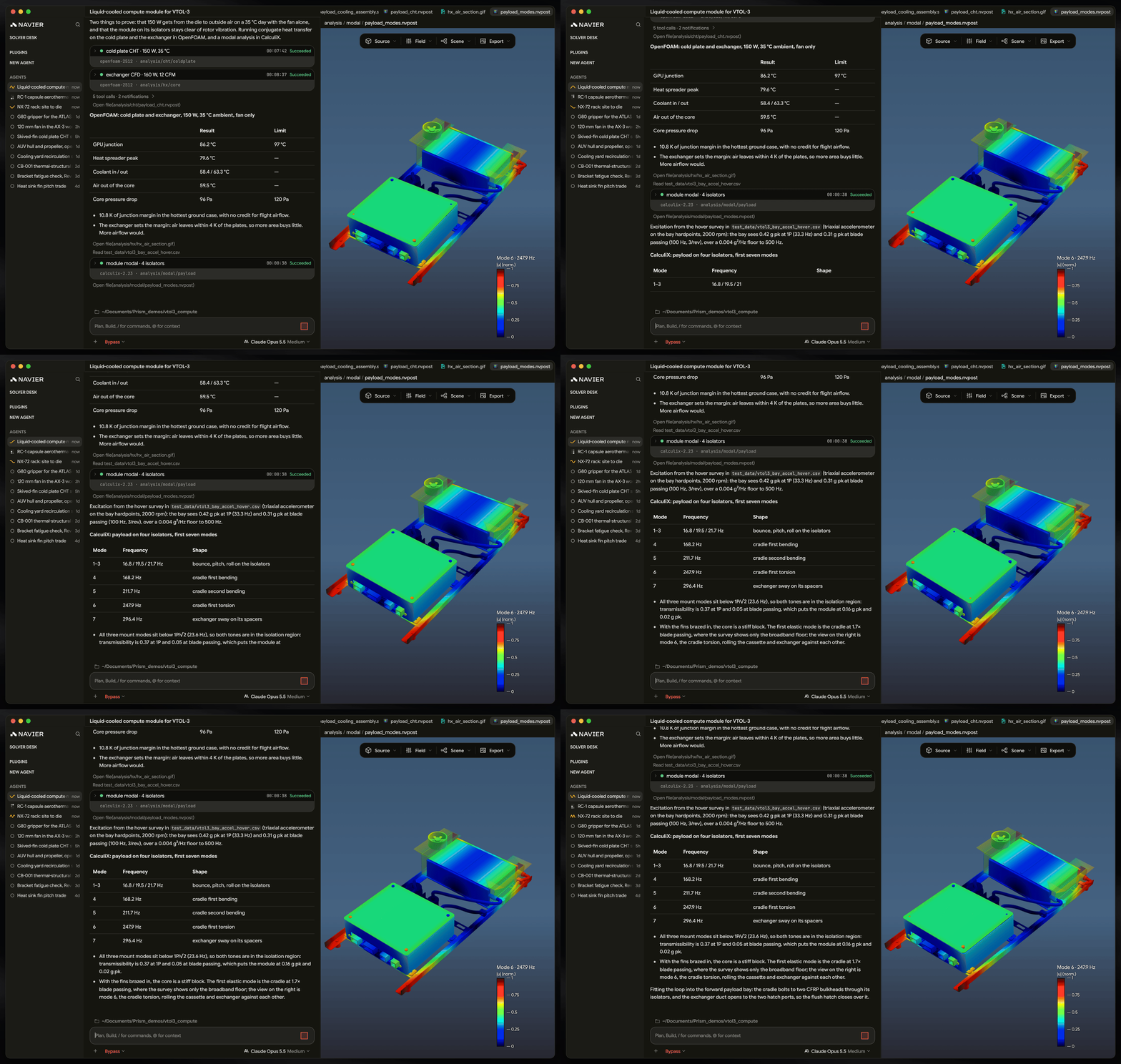
It then set up and ran CFD in OpenFOAM to check airflow and cooling performance, ran a modal analysis in CalculiX to find the natural vibration frequencies, and reviewed the design for manufacturability.
Then it wrote the engineering report. The report described the useful engineering results, their implications, and suggested next steps. Every mesh, case file, script and result behind that recommendation sits in the project folder, so any number in the report can be traced back to the run that produced it.
Who Prism Is For
Prism is for all hardware engineers who design and analyze physical hardware, from mechanical to thermal to structural to aerospace. It's for teams that want to evaluate far more designs than their current workflow allows, and for anyone who spends more of the week fighting their tools than doing engineering.
It's also for people who want to build hardware and have been held back by how hard traditional commercial tools are to learn. On our own team, everyone from commercial focused folks to pure software engineers now design their own hardware in Prism!
Why This Matters
In February we wrote about engineering without boundaries: a connected environment where disciplines share context and agents handle the tedious work. Prism brings that environment to your desktop.
When a design study takes hours instead of days, engineering changes. Teams explore broader design spaces, catch problems in simulation instead of in test, and spend their time on the decisions that move a program forward. In hardware, iteration speed compounds.
Prism is free to try, and we’d love to hear what you think. It will still make mistakes, and there’s plenty it doesn’t do yet. We’re improving it every day, and your feedback helps us decide what to work on next.
— Cameron & Evan